Course description

Practical French grammar focuses on functional application—using grammatical structures for real-life communication rather than just memorizing rules. Key learning outcomes include mastering essential sentence structures, improving conversational fluency, and accurately navigating everyday social and professional situations in French-speaking environments

What will I learn?

  • Real-Life Communication: Ability to handle short social interactions, order food, ask for directions, and participate in basic conversations in the present tense.
  • Essential Mechanics: Mastery of noun gender, adjective agreement, and correct use of articles (le, la, les, un, une)
  • Time and Narration: Practical control of the present tense, immediate future (futur composé), and recent past (passé composé) to describe daily activities and past events.
  • Pronoun Usage: Proper substitution using direct/indirect object pronouns and the tricky pronouns y and en to make speech sound natural
  • Functional Writing: Writing brief emails, making comparisons, and presenting information on familiar topics

Requirements

  • Internet
  • Laptop/Desktop

Frequently Asked Question

A: French has three primary ways to ask questions, ranging from formal to informal:Intonation (Informal): State the sentence normally but raise your pitch at the end. (e.g., Tu manges ? - Are you eating?)Est-ce que (Standard): Add est-ce que at the beginning of the statement. (e.g., Est-ce que tu manges ?)Inversion (Formal): Flip the subject pronoun and the verb, separated by a hyphen. (e.g., Manges-tu ?)

A: Both are past tenses, but they serve different functions:Passé Composé: Used for completed, specific actions with a defined beginning and end (e.g., J'ai mangé une pomme - I ate an apple).Imparfait: Used for ongoing actions, background descriptions, habits, and states of being (e.g., Je mangeais une pomme - I was eating an apple, or Il faisait beau - The weather was nice).

A: Most French verbs use avoir as the helping verb. However, use être for two categories of verbs:Verbs of motion or state change (e.g., aller (to go), venir (to come), tomber (to fall)).All reflexive verbs (e.g., se laver - to wash oneself).

The 14 main "Dr. & Mrs. Vandertramp" verbs (and their derivatives) take être. You can remember them with the acronym: D R . & M R S . V A N D E R T R A M PDescendre (to go down)Retourner (to return)&Monter (to go up)Rester (to stay)Sortir (to go out)Venir (to come)Aller (to go)Naître (to be born)Devenir (to become)Entrer (to enter)Rentrer (to go back in)Tomber (to fall)Retourner (to return)Arriver (to arrive)Mourir (to die)Partir (to leave)

In French, negation frames the verb. You wrap the verb in ne (or n') and pas

A: The subjunctive (le subjonctif) is used in the dependent clause of a sentence to express emotion, doubt, desire, or necessity. It usually follows the word que and expressions like il faut que (it is necessary that) or je veux que (I want that).e.g., Je veux que tu manges (I want you to eat).

A: Not really. Inversion is mostly reserved for formal writing, official documents, and highly elevated speech. For daily conversations and casual interactions, using est-ce que or simply raising your voice's intonation at the end of a sentence is the standard.If you want to focus on a specific area, tell me:What level of French are you at (Beginner/A1, Intermediate/B1, Advanced)?Are there specific grammar topics you struggle with (e.g., prepositions, pronouns, conjugations)?

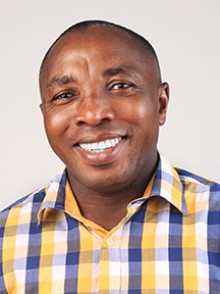
Watt Fiedin Adams

I am a Ghanaian businessman living in Accra and father to Godstime Watt Fiedin. I am very passionate about Entrepreneurship and aim at creating jobs for the youth. I like teaching and creating teaching contents for others to use. Jesus is my Mentor and Inspiration.

I am a Ghanaian/American businessman living in Accra and father to Godstime Watt Fiedin.I am very passionate about Entrepreneurship and aim at creating jobs for the youth.I like teaching and creating teaching contents for others to use.Jesus is my Mentor and Inspiration. - 18 years of teaching experience in French Language.- 3 years in Economic Business- 3 years Certified Interpreter/Translator, World Vision International, Ghana, West Africa Region & Global Center- 2 years Certified Translator, HIPPO Transport Ltd.- 3 years of French/English book Authorship.- 1 year as President of the Online Linguistics Trainers Association, Ghana.- 3 years as Chief Executive Officer, WATT Group of Companies- Director, WATT E-School of Languages- President, Online Linguistics Trainers Association, Ghana- President, WATT Xpress Ltd.- Co-founder, Gallery Products Ghana Ltd.- CEO, WATT Publications Ltd.- Interpreter, Lausanne Movement- Co-founder, WATT E-School- C. E. O. / Founder - WATT Professional Studies LLC- Test Administrator (PSI & Pearson VUE)
Free

Lectures

28

Skill level

Beginner

Expiry period

12 Months

Certificate

Yes

Related courses