Course description

French grammar is structured around grammatical gender, adjective-noun agreement, and rigorous verb conjugations. It follows a Subject-Verb-Object (SVO) word order but modifies sentences significantly with complex pronoun replacements, negations, and the subjunctive mood. 

What will I learn?

  • The Building Blocks: Nouns, Adjectives, and PronounsNoun Gender & Number: Master the gender of nouns (masculine/feminine) and form plurals correctly to ensure accurate article agreement.Adjective Agreement: Apply rules for placing adjectives (like BAGS rule) and match them in gender and number with the noun they modify.Pronoun Mastery: Use direct/indirect object pronouns, possessive and demonstrative pronouns, and adverbial pronouns (y, en) to avoid repetition and achieve textual cohesion
  • Verb Conjugation and Tense SystemsThe Present Tense: Confidently conjugate regular (-er, -ir, -re) and irregular verbs (être, avoir, faire, aller) in the present tense.Past Narratives: Differentiate and apply the passé composé (completed actions) and the imparfait (background descriptions, habits) in storytelling.Future and Conditional: Use the futur proche (immediate future) and futur simple (distant future), as well as the conditional mood (le conditionnel) to express hypothetical scenarios
  • Syntax and Complex StructuresThe Subjunctive: Understand the subjonctif to express desires, doubts, emotions, or necessities (e.g., Il faut que tu viennes).Relative Clauses: Connect sentences using relative pronouns (qui, que, dont, où) to build complex, fluid thoughts.Passive vs. Active Voice: Form passive sentences and pronominal verbs (reflexive/reciprocal) to accurately depict who or what is performing the action.
  • Spoken vs. Written FluencySpoken Fluency: Internalize sound blending (liaison), silent letters, and nasal vowels to comprehend and produce natural, phonetic spoken French.Written Precision: Spell and structure essays or professional correspondence while observing advanced grammatical nuances, such as advanced past participle agreement.

Requirements

  • Internet
  • Laptop/Desktop

Frequently Asked Question

All French nouns are either masculine (le / un) or feminine (la / une). While there are no perfect rules, endings can offer clues: words ending in -e or -ion are often feminine, while words ending in double consonants or -eau are usually masculine. Memorizing nouns with their articles is highly recommended

Adjectives must agree in gender (masculine/feminine) and number (singular/plural) with the noun they describe. For example, a small car (une petite voiture) uses the feminine adjective, while a small dog (un petit chien) uses the masculine

When a short, one-syllable word (like je, le, la, or que) is followed by a word starting with a vowel or a mute "h", the vowel is dropped and replaced with an apostrophe (e.g., je + aime becomes j'aime).

French verbs are categorized into three groups: regular -er verbs, regular -ir verbs, and irregular verbs (which primarily end in -re). Regular verbs follow a set pattern, while irregular verbs must be memorized individually

While both verbs are heavily used, être is used for all reflexive verbs, the passive voice, and a specific list of movement/state-of-being verbs (e.g., aller, venir, tomber). Avoir is used for all other verbs

Both represent the past tense. The Passé Composé is used for specific, completed actions with a defined start or end point. The Imparfait describes ongoing actions, habits, or background details (e.g., the weather, age, feelings).

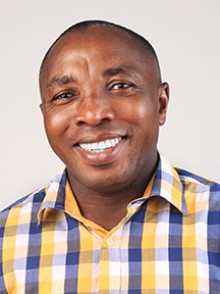
Watt Fiedin Adams

I am a Ghanaian businessman living in Accra and father to Godstime Watt Fiedin. I am very passionate about Entrepreneurship and aim at creating jobs for the youth. I like teaching and creating teaching contents for others to use. Jesus is my Mentor and Inspiration.

I am a Ghanaian/American businessman living in Accra and father to Godstime Watt Fiedin.I am very passionate about Entrepreneurship and aim at creating jobs for the youth.I like teaching and creating teaching contents for others to use.Jesus is my Mentor and Inspiration. - 18 years of teaching experience in French Language.- 3 years in Economic Business- 3 years Certified Interpreter/Translator, World Vision International, Ghana, West Africa Region & Global Center- 2 years Certified Translator, HIPPO Transport Ltd.- 3 years of French/English book Authorship.- 1 year as President of the Online Linguistics Trainers Association, Ghana.- 3 years as Chief Executive Officer, WATT Group of Companies- Director, WATT E-School of Languages- President, Online Linguistics Trainers Association, Ghana- President, WATT Xpress Ltd.- Co-founder, Gallery Products Ghana Ltd.- CEO, WATT Publications Ltd.- Interpreter, Lausanne Movement- Co-founder, WATT E-School- C. E. O. / Founder - WATT Professional Studies LLC- Test Administrator (PSI & Pearson VUE)
Free

Lectures

15

Skill level

Beginner

Expiry period

12 Months

Certificate

Yes

Related courses